
1000 Words on: 1000 Words
A 1000-word limit forces me to narrow down big ideas, to capture key concepts, without excluding what is important. Like an artist or a photographer, I am attending to what is inside the frame of my lens. My hope is that within the limitation of 1000 words is a clear look into aspects of our inner lives. I want it to be readable, comprehensible, and digestible as well as relevant and helpful.
Douglas Holwerda
The saying says, “A picture is worth a thousand words.” A picture can tell a story that is clear and concise from the images it creates or captures. Here, I am flipping it around, telling a clear and concise story, a picture of our inner life from the words I choose. These ideas are snapshots or glimpses into the components of our inner life and how they influence each other. A 1000-word limit forces me to narrow down big ideas, to capture key concepts, without excluding what is important. Like an artist or a photographer, I am attending to what is inside the frame of my lens. My hope is that within the limitation of 1000 words is a clear look into aspects of our inner lives. I want it to be readable, comprehensible, and digestible as well as relevant and helpful.
Most of the ideas I choose to write about are drawn from the 25 years of experience I have as a psychotherapist in the U.S. and Vietnam. Over that time, I have gained insight into the inner workings of the human psyche by seeing how people respond to what they are going through. I have decided to write a book about it, not yet published, entitled, “Living From the Inside Out”. The book starts with the common idea that we all have a potential, the potential to become our whole true self. We also have obstacles and limitations that keep most of us from being empowered to live the life that is ours to live. Our inner life… our emotions, our thoughts and our bodies are each a source of information, guiding our behaviors and shaping the persons we become. When we have self-knowledge and become self-aware, we regulate our inner life in ways that liberate us from the limitations most of us live within. Carl Jung said it this way, “Like a plant, which from a seed, becomes an Oak tree, so we become what we are meant to be… but we get stuck.” It is our awareness of and our relationship to our inner life that gets us “unstuck”.
Of course, there is a lot to it. Humans are complex beings, effected greatly by the needs we have during our formative years. We, unlike turtles, need parents and adults to raise us, meeting the needs we have to develop a confident sense of self-acceptance. It is often during the years of childhood and adolescents that we take on emotions and beliefs that, ultimately, become the limitations to the process of becoming our whole true self. We might judge ourselves harshly, diminished in our sense of worth, or we might carry unresolved emotion, such as guilt, fear or anger that inhibit us from feelings of self-acceptance and empowerment. We take in messages, we create standards, we compare ourselves to others, seeking approval and belonging. When we do not feel safe, we live with fears and protect ourselves with vigilance while neglecting our inner life where, as Lao Tzu says, “we know who we are and what we want”.
We, humans, are amazing at finding ways to cope when the conditions of our lives are not fully supportive. It is a good thing to find our way through the challenges of life when we don’t really know what to do, but coping is not the same as living from the inside out. Coping is meant to be for the short run, while, when we know and accept ourselves, we are able to express a life that is a reflection of who we are and what we want…our unique version of the human experience.
In simple terms these 1000-word essays are each a piece of a puzzle, that when put together paint a broader picture of who we are and what it means to be human in all the messiness that comes from life. “Living From the Inside Out” is my attempt to broaden the view we can have and to look more closely into what it is that represents the challenges of our inner life. Depression, anxiety, grief, and many other aspects of our emotional experiences are common to the human experience and we know more than ever that we can regulate ourselves in ways that help us free ourselves from those internal traps, those patterns and mechanisms that take shape before we are ready to understand them. We can also become clear that our sense of worth is often damaged by messages that are aimed at our behavior, not the essence of who we are. We over-identify with ideas of who we are at the expense of the experience of living life unencumbered by judgments and self-deprecating beliefs. When we live present to our bodies, experiencing life as we live it, we distance ourselves from ideas we have of who we are as well as who we think others think we are. When we are free to live, we have less care or concern about the ideas of who we are in favor of being who we are.
1000 words, can paint a picture or it can be like a meal. It can satisfy our hunger to know ourselves, while realizing that we will continue to eat and learn more about who we are. It is enough for now, until we are hungry again. 1000 words can point to truths that are familiar to us, but which are formulated in ways that help us understand with clarity. Concise and clear ideas help us to create order in our thinking. Order is useful, counter-acting the confusion and chaos that also come with life, reducing the anxiety we have that comes with uncertainty.
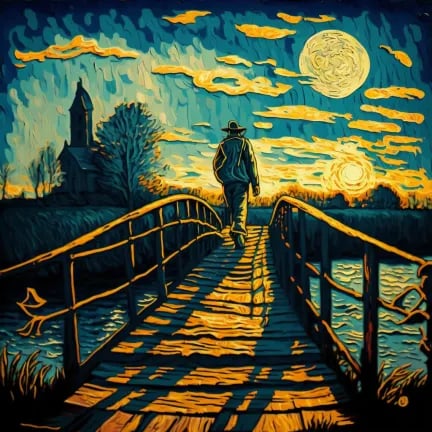
For each 1000-word essay, we have generated a picture through an AI system that pulls together the key concepts and reflects it back in a way that Vincent Van Gogh might have. The words paint a picture and the picture created, tells us more than words can say. A remarkable possibility in our times.